
The Farmland Trap: Why That Cheap Akiya with Rice Paddies Isn't Automatically Yours
Rice paddies, fields and forest attached to a rural Japanese house are governed by the Farmland Act and forestry rules. Learn how Article 3 approval, blue land, irrigation districts and forest notifications really work.
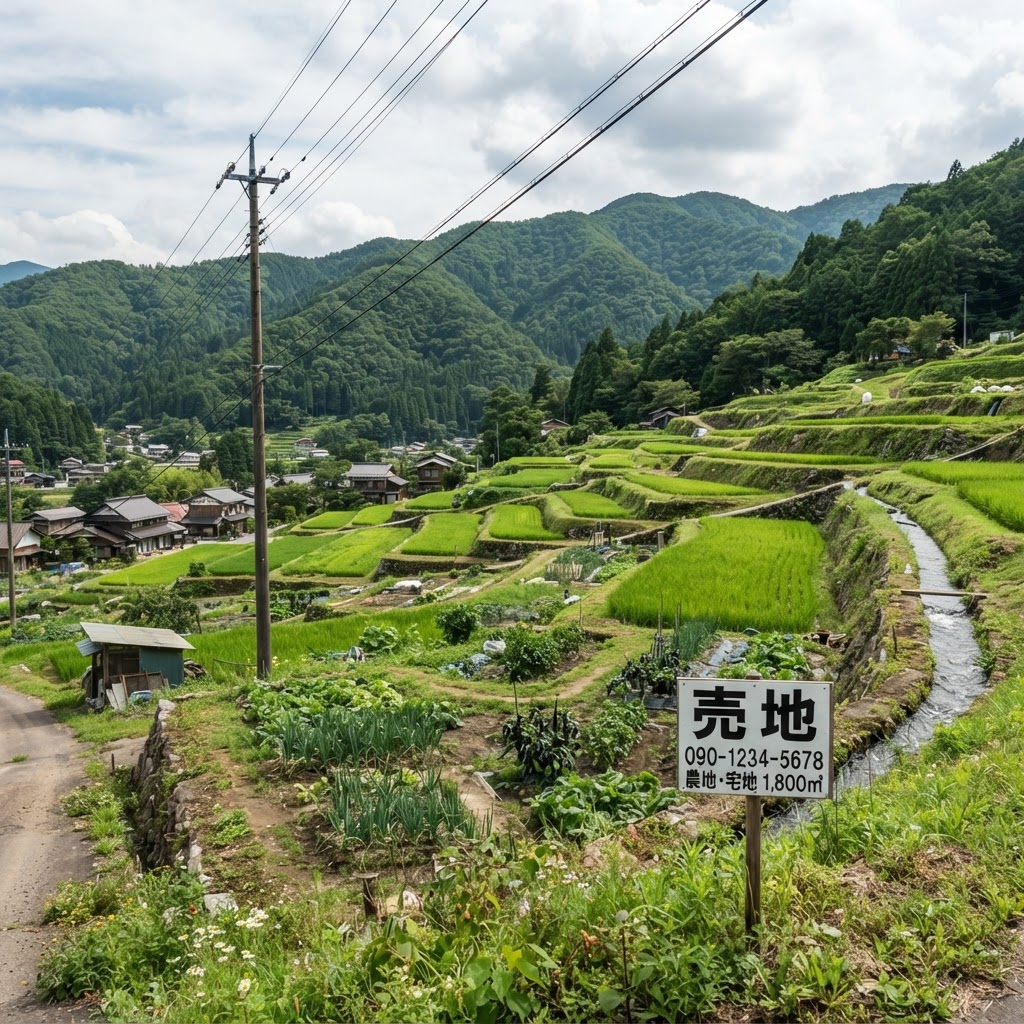
A rural property should be analysed as a bundle of parcels and regulatory overlays, not as one “house with land.” The sales listing may describe all surrounding land as part of the property, while the registry separately classifies the parcels as residential lot (宅地), rice paddy (田), field (畑), forest (山林) or miscellaneous land. Each category carries its own rules — and agricultural authorities may treat the actual use as more important than the label in the advertisement.
Article 3: the approval most buyers don't know about
An acquisition or lease of farmland for farming ordinarily requires Agricultural Committee (農業委員会) permission under Article 3 of the Farmland Act. MAFF states plainly that a transaction requiring Article 3 approval is invalid without it. The buyer must show the land will be used efficiently and that the proposed farming is credible — purchase solely as a passive investment or a big garden is not permitted. Nationality is not the central test; ability and intention to farm properly are.
The former national minimum-area requirement has been abolished, which makes small-scale entry more feasible — but the substantive farming tests remain. Local committees may ask about residence, travel time, labour, equipment, farming knowledge, use of all parcels, and participation in shared irrigation or road maintenance.
Conversion is a separate battle
Using farmland for a building, guest parking, glamping deck, widened driveway, septic field, swimming pool or a purely residential garden may constitute conversion (農地転用) — controlled separately from acquisition. Even “white land” (白地) outside the agricultural-use zone still needs conversion permission or notification. Never buy on the assumption that conversion “should be possible.”
Paddies come with plumbing and neighbours
A rice paddy may depend on communal irrigation managed by a Land Improvement District (土地改良区). Ownership can bring annual assessments, canal-cleaning days, water schedules, obligations to maintain banks and channels, and limits on when water is available. Speak directly with the district and adjoining farmers before committing.
| Issue | Red flag | Mitigation |
|---|---|---|
| Irrigation | No documented water access; broken upstream channel; neighbour dispute | Request water rights (水利権), irrigation map, assessments and operating calendar |
| Drainage | Runoff enters the house site; outlet crosses another owner's land by custom | Civil-engineer drainage design and written easements |
| Soil | Construction debris, waterlogging, unknown chemical history | Soil testing for nutrients, pH and contaminants appropriate to intended crops |
| Access | Tractor access only across a neighbour's parcel by custom | Registered access rights or a written long-term agreement before purchase |
| Cultivation obligation | Large fragmented acreage purchased for “future ideas” | Acquire or lease only what a practical farm plan supports |
Forest and livestock have their own rulebooks
New forest ownership normally requires notification to the municipality within 90 days (森林の土地の所有者届出), and tree cutting can require advance notification plus post-cutting reporting. Boundaries in forest parcels are often unsurveyed — budget for a surveyor. Even a small non-commercial flock or herd is subject to MAFF's husbandry hygiene standards, including the non-commercial standards added in the 2025 revisions; check with the prefectural livestock hygiene service before planning chickens, goats or bees.
Farmland due-diligence checklist
Complete every item before your offer becomes unconditional.
Sources & references
- MAFF — Farmland Act and acquisition explained (農地をめぐる事情)
- MAFF — Agricultural promotion areas and farmland conversion permission
- MAFF — Corporate entry into farming: Q&A on conditional leases
- Forestry Agency — Forest land ownership notification system
- MAFF — Husbandry hygiene management standards (飼養衛生管理基準)
Keep reading
Can Foreigners Buy Property in Japan? Ownership, Structures, and What It Doesn't Get You
Foreign individuals and companies can generally own Japanese land and buildings — but ownership gives you no visa, no farmland rights, and no lodging licence. Here's how to structure a rural purchase correctly.
Zoning, Road Access, and the House You Can't Rebuild
A standing house is not proof you may rebuild it. Urbanization-control areas, the 2-metre road-frontage rule, existing-nonconforming buildings and unregistered extensions — the planning checks that decide a rural purchase.
Water, Roads, and Snow: The Rural Infrastructure and Hazard Screen
A structurally sound house can still be unusable: undocumented spring-water rights, undersized septic tanks, winter road closures, flood-prone access bridges. How to screen utilities and natural hazards before buying.